
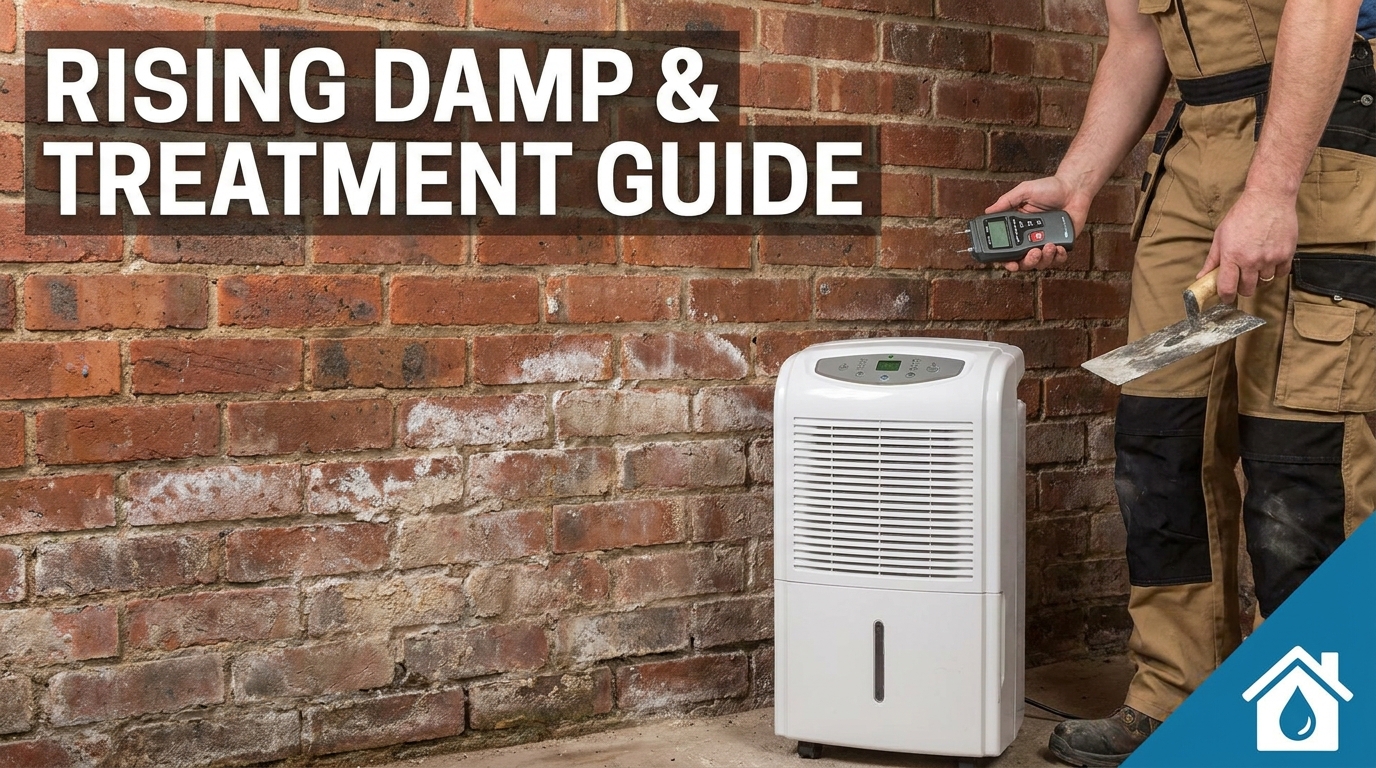
Rising damp is one of the most frequently encountered yet frequently misunderstood moisture problems in UK homes. For homeowners and landlords across Bournemouth and Dorset, it can feel alarming when damp patches appear low on internal walls, plaster begins to deteriorate, or a musty smell becomes impossible to ignore. Understanding what causes rising damp is the first step towards resolving it properly and protecting your property for the long term.
At Bio-Kil, we have been helping homeowners and landlords across Bournemouth and Dorset diagnose and treat damp problems for many years. In this guide, we explain the science behind rising damp, the conditions that allow it to take hold, how it is commonly mistaken for other moisture issues, and how we treat it effectively.
What Is Rising Damp?
Rising damp is the upward movement of ground moisture through the porous fabric of a wall. Bricks, mortar, and stone all contain tiny interconnected pores, and through a process known as capillary action, water is drawn upwards against the force of gravity. Think of it in the same way that a paper towel absorbs liquid from the surface it is placed on.
In practice, rising damp rarely climbs higher than around one metre above floor level. The moisture carries dissolved ground salts with it as it travels, and it is these salts that often leave visible evidence on your walls. The Property Care Association describes rising damp as the result of external ground water being drawn upward through brickwork by capillary action, and distinguishes it clearly from other forms of moisture ingress.
Left untreated, this upward wicking of moisture can cause significant damage to plasterwork, decorative finishes, skirting boards, and even timber elements within the wall construction.
The Role of the Damp Proof Course (DPC)
In most properties built after the late 19th century, a damp proof course was incorporated into the construction. A damp proof course is a physical barrier, typically a layer of impermeable material such as slate, bitumen, or modern plastic membrane, built horizontally into the wall just above ground level. Its purpose is to interrupt the capillary rise of moisture and prevent it from travelling further up the wall.
When a damp proof course is functioning correctly, rising damp is stopped in its tracks. Problems arise when the DPC fails, becomes damaged, or is bridged by external materials. In older properties, particularly Victorian and Edwardian homes that are common across the Bournemouth and Dorset area, the original slate DPC may have deteriorated over time, become cracked, or may not have been installed at all.
UK Building Regulations, set out in Approved Document C, provide guidance on protecting buildings from ground moisture, reinforcing just how important a functioning damp proof course is to the integrity of a property.
External Ground Levels and Drainage Issues
One of the most common yet easily overlooked causes of rising damp is raised external ground levels. When soil, paving, decking, or garden borders have been built up against the outside of a wall over time, they can sit above the level of the damp proof course. This effectively bridges the DPC, creating a direct pathway for ground moisture to bypass the barrier and enter the wall.
This is a particularly common issue in older terraced properties and those that have had landscaping works carried out without consideration for the DPC height. As a general rule, external ground levels should sit at least 150mm below the damp proof course.
Poor external drainage compounds the problem further. If rainwater is not being directed away from the building effectively, water can pool or saturate the ground immediately adjacent to the walls. Blocked or leaking drains, improperly graded paving, and overfilled flower beds all contribute to the volume of moisture available to travel upward through the wall structure.
Addressing external drainage and ensuring ground levels are appropriate are therefore important parts of any long-term rising damp solution.
Hygroscopic Salts and What They Mean for Your Plasterwork
As ground moisture travels upward through masonry, it carries with it a range of soluble salts drawn from the soil and the wall materials themselves. When the moisture evaporates at the wall surface, these salts are deposited within the plaster and on the wall's surface. Over time, they accumulate and form what is known as a hygroscopic salt contamination.
Hygroscopic salts are hygroscopic by nature, meaning they attract and absorb moisture from the surrounding air. This creates a particularly frustrating situation: even after the source of rising damp has been addressed and the DPC repaired or replaced, the old plasterwork continues to feel damp and look stained because it is drawing moisture from the air whenever humidity levels rise.
The Property Care Association's guidance on hygroscopic salts confirms that salt-contaminated plaster must be removed and replaced as part of any effective treatment programme. Applying new decoration or fresh plaster over contaminated material without addressing the salts will almost always result in the problem returning.
This is why a thorough rising damp treatment always involves replastering with a specialist salt-resistant render or renovating plaster system, not simply redecorating over the affected area.
Common Misconceptions: Is It Always Rising Damp?
Rising damp is one of the most misdiagnosed problems in the property industry. Many cases that are identified as rising damp are in fact caused by condensation, penetrating damp, or leaking plumbing and drainage. Understanding the differences is essential to applying the correct treatment.
Condensation forms when warm, moisture-laden air meets a cold surface and the water vapour converts to liquid. It tends to affect large areas of wall, particularly in corners, behind furniture, and at ceiling level. Condensation is frequently confused with rising damp, particularly in poorly ventilated properties. You can read more about how we approach condensation problems on our condensation treatment page.
Penetrating damp enters a property horizontally through defects in the external fabric, such as cracked render, failed pointing, damaged window reveals, or leaking gutters. Unlike ascending dampness, penetrating damp is not restricted to the lower sections of a wall and will often track the line of a defect rather than appearing as a consistent horizontal tidemark.
Leaking internal plumbing or drainage can also cause damp patches that are mistaken for rising damp, particularly in bathrooms, kitchens, and ground-floor rooms adjacent to drainage runs.
The Society for the Protection of Ancient Buildings (SPAB) emphasises the importance of thorough diagnosis before any treatment is carried out, noting that misidentification is widespread and can lead to unnecessary and ineffective remedial works. This is a view we share entirely.
Ventilation and Sub-Floor Moisture
In properties with suspended timber ground floors, inadequate sub-floor ventilation can contribute significantly to moisture problems within the lower sections of walls and floor timbers. Air bricks are designed to allow air to circulate beneath the floor, preventing moisture from building up in the sub-floor void. When air bricks become blocked, painted over, or are insufficient in number, moisture levels beneath the floor rise, creating conditions that can cause timber decay and contribute to damp in adjoining wall areas.
Maintaining clear air bricks and ensuring adequate sub-floor ventilation is an important part of keeping ground-floor moisture under control. Where ventilation is insufficient, modern sub-floor ventilation systems can be installed to actively manage air movement. You can find out more on our sub-floor ventilation page.
How Rising Damp Is Diagnosed
Accurate diagnosis is everything. Before any treatment is recommended, we carry out a thorough inspection of the affected areas, which includes the use of calibrated moisture meters to measure moisture content within the wall at various heights, and a detailed assessment of external conditions including ground levels, drainage, and the condition of the DPC.
We also examine the pattern and characteristics of the damp. Genuine rising damp typically presents as a distinct horizontal tidemark with associated salt staining and plaster deterioration within the lower metre of the wall. The presence of hygroscopic salts, combined with moisture readings that taper off as you move higher up the wall, are strong indicators.
Where there is uncertainty, further investigation into external factors such as drain runs, gutter condition, and render integrity will be carried out before any diagnosis is confirmed and any treatment recommended.
How We Treat Rising Damp
Once rising damp has been properly diagnosed, the most widely used treatment in modern remedial practice is the installation of a chemical damp proof course. This involves injecting a specialist DPC fluid into a line of drilled holes at the base of the affected wall. The fluid permeates the masonry and creates an impermeable barrier that replicates the function of the original physical DPC.
Following the installation of the chemical DPC, all salt-contaminated plaster must be carefully removed and replaced. We use a specialist salt-resistant renovation plaster system that prevents residual hygroscopic salts from drawing moisture through the new finish, giving you a clean, stable wall surface that will accept redecoration correctly.
Where external ground levels are the primary or contributing cause, we will advise on the appropriate remediation of those factors as part of the overall treatment plan, ensuring that the solution addresses the root cause and not just the symptoms.
Our damp treatment services are backed by a 20-year guarantee, giving homeowners and landlords the confidence that the work has been carried out to the highest standard.
Why Bournemouth and Dorset Homeowners Trust Bio-Kil
We understand how disruptive and worrying damp problems can be, and our focus is always on delivering clear, honest advice alongside effective, lasting solutions. Our customers repeatedly tell us what they value most about working with us.
One customer told us: "Prompt, effective and efficient. I have used Bio-Kil many times for the problems in my rented properties especially with damp. They always offer a professional approach and leaves the property as they found it with the problem solved."
Another commented: "Thanks to Brooke and the team for an excellent job solving my damp problem. From start to finish they were friendly and professional. I would highly recommend Bio-Kil."
Our process is straightforward and designed to take the stress out of dealing with damp. We begin with a detailed survey to identify the true cause of the problem, provide a clear written report and tailored treatment plan, and then carry out proven remedial works to restore and protect your property.
If you are a homeowner or landlord in Bournemouth or Dorset and you are concerned about rising damp or any other moisture issue, we are here to help. Contact us today to book a survey or request a quote, and let us give you the honest assessment your property deserves.