
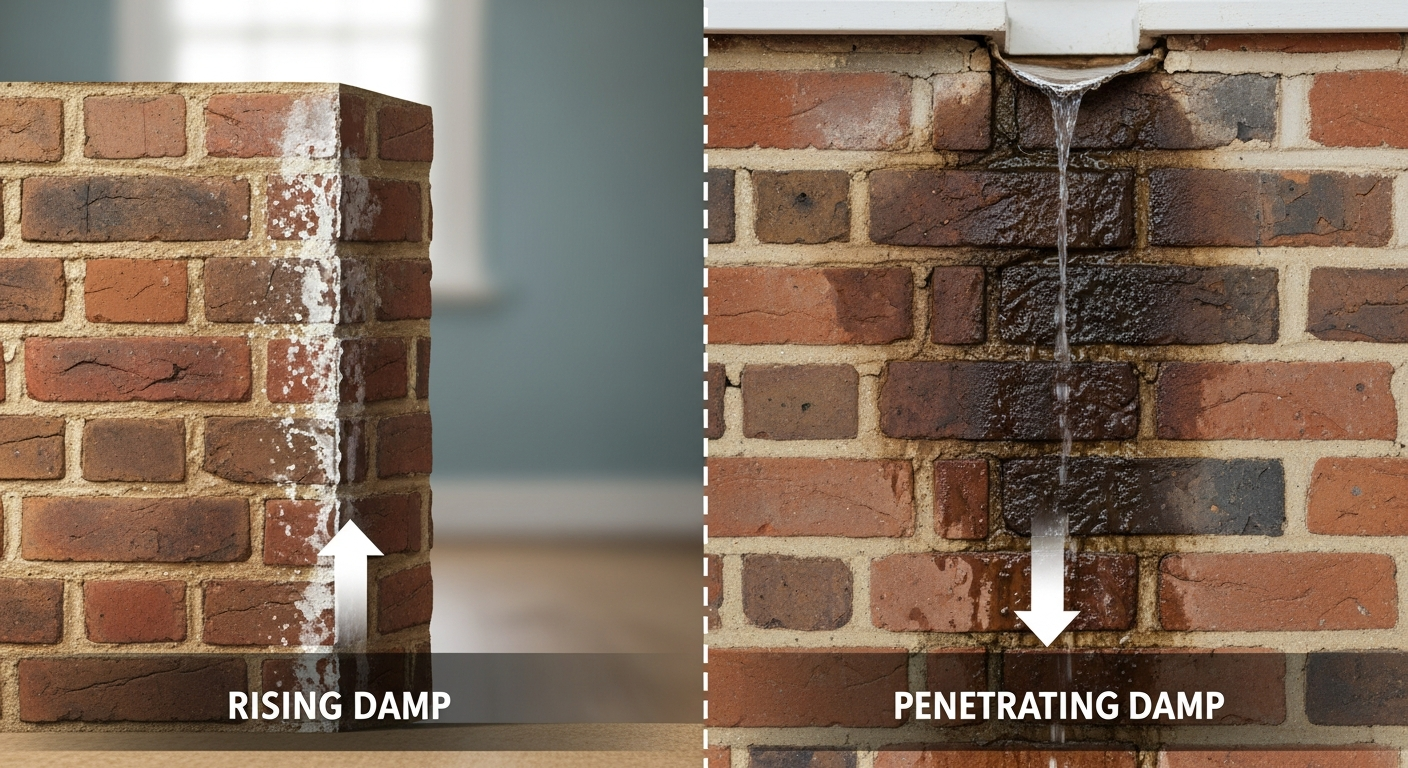
Rising damp and penetrating damp are two of the most common moisture-related problems affecting properties across Bournemouth, Dorset, and throughout the UK. While both can cause serious structural and cosmetic damage if left untreated, they have very different causes, patterns of behaviour, and treatment requirements. Misidentifying one for the other is a costly error, and one we see far too often when property owners attempt remediation without a proper professional diagnosis.
In this guide, we explain the practical distinctions between rising damp and penetrating damp, the signs to look for in each case, and how we approach treating both.
What is Rising Damp?
Rising damp occurs when groundwater from the surrounding soil is drawn upward through a building's masonry and walls by a process known as capillary action. Just as a dry sponge absorbs water when placed on a wet surface, brickwork and mortar will draw moisture vertically upward when no effective barrier exists to prevent it. This barrier is known as a damp-proof course (DPC), and in many older properties across Bournemouth and Dorset, the DPC may be absent, deteriorated, or bridged by raised external ground levels, leaving the building vulnerable to soil moisture movement from below.
According to the Property Care Association, rising damp is defined by the upward movement of groundwater through masonry via capillary action, and it can result in lasting damage to a property if no action is taken.
Signs of Rising Damp
Rising damp typically produces a recognisable tide mark on the lower sections of a wall, rarely reaching higher than around one metre above floor level. As the moisture travels upward, it carries soluble salts from the ground, which are deposited on the wall surface as the water evaporates. These salt deposits can remain visible long after the wall appears to have dried out. Common signs include:
- Damp patches concentrated at the base of walls and around skirting boards
- A visible tide mark or horizontal staining on internal plaster
- White crystalline deposits, known as efflorescence, on masonry or plaster surfaces
- Peeling wallpaper or bubbling paintwork at low level
- Soft, crumbling, or deteriorating plaster near floor level
- A persistent musty odour in the affected room
What is Penetrating Damp?
Penetrating damp, sometimes referred to as rainwater ingress or moisture penetration, occurs when water enters a building horizontally through defects in the external fabric of the structure. Unlike rising damp, it is not driven by capillary action from the ground but by external water finding a route inward through the building envelope. Common causes include cracked or porous render, failed mortar pointing between bricks, defective window or door frames, blocked or leaking gutters and downpipes, and deteriorating roof flashings.
In coastal locations such as Bournemouth, where properties are regularly exposed to wind-driven rain and salt-laden air, penetrating damp is a particularly common and persistent challenge. UK Government guidance highlights the serious health risks associated with damp and mould in the home, reinforcing why prompt, effective action is so important for both residential and commercial property owners.
Signs of Penetrating Damp
Because penetrating damp is driven by external water ingress, its symptoms are typically linked to specific defects in the building's exterior. Signs to look for include:
- Damp patches appearing on internal walls or ceilings following periods of rainfall
- Moisture staining at various heights on walls, not just at lower levels
- Damp or discolouration near windows, doors, chimney breasts, or roof junctions
- Mould growth on interior wall surfaces or ceilings
- Spalling, staining, or visible damage to external brickwork
- Localised wet patches that worsen after heavy rain but improve during dry spells
That last point is one of the most useful practical distinctions between the two types of damp. Penetrating damp tends to be strongly weather-dependent, becoming notably worse following rainfall. Rising damp, by contrast, tends to persist as a constant presence regardless of short-term weather conditions.
Rising Damp vs Penetrating Damp: Key Differences at a Glance
To summarise the most important distinctions:
- Source: Rising damp originates from groundwater beneath and around the building. Penetrating damp comes from external water entering through defects in walls, roofs, or openings.
- Direction of movement: Rising damp travels vertically upward through masonry. Penetrating damp moves horizontally inward through the building fabric.
- Location on the wall: Rising damp is almost always confined to the lower sections of walls. Penetrating damp can appear at any height.
- Weather dependency: Penetrating damp typically worsens during heavy rainfall. Rising damp is not directly influenced by short-term weather changes.
- Salt deposits: White crystalline salt staining is a strong indicator of rising damp and is rarely associated with penetrating damp.
Treatment Options for Rising Damp
The most widely used and effective treatment for rising damp involves the installation of a new chemical damp-proof course. This process typically involves drilling a series of closely spaced holes along the base of the affected wall and injecting a specialist damp-proofing cream or fluid into the masonry. The chemical diffuses through the wall to create a new moisture barrier, blocking further capillary action. Once the new DPC is in place, affected plaster must be removed and replaced with a salt-resistant renovation plaster to prevent residual ground salts from damaging the new finish.
Our damp proofing treatments are carried out by trained and experienced specialists and are backed by our 20-year guarantee, providing genuine long-term protection and reassurance for both homeowners and commercial property operators.
Treatment Options for Penetrating Damp
Because penetrating damp is caused by specific defects in the building's exterior, successful treatment depends on identifying and resolving those defects at source. Depending on the nature of the problem, this may involve:
- Repointing deteriorating mortar joints in brickwork or stonework
- Applying masonry water repellent treatments to external elevations
- Repairing or renewing damaged, cracked, or porous render
- Clearing, repairing, or replacing gutters, downpipes, and drainage channels
- Installing waterproofing membranes or damp-proof barriers where required
- Sealing failed window and door frames, flashings, and roof junctions
As the RICS consumer guide on damp and mould makes clear, identifying the precise source of moisture ingress is critical to achieving a lasting result. Treating the symptoms without addressing the root cause will always be a short-term fix at best.
Why a Professional Survey is the Essential First Step
One of the most frequent errors property owners make is attempting to treat damp before confirming what type they are actually dealing with. Applying the wrong treatment is not only ineffective; it can conceal a deeper structural issue and lead to significantly greater expense further down the line.
At Bio-Kil, we follow a structured four-step process to ensure every damp problem across Bournemouth and Dorset is correctly diagnosed and effectively resolved:
- Book a Survey – Arrange a convenient appointment anywhere in Bournemouth or Dorset.
- Detailed Inspection – We carry out a full survey to identify damp, woodworm, or rot problems.
- Clear Report and Quote – Receive straightforward recommendations with a tailored treatment plan.
- Treatment and Protection – Our team deliver proven solutions to restore and protect your property.
Our customers consistently tell us how much they value this approach. One long-standing client shared: "Prompt, effective and efficient. I have used Bio-Kil many times for the problems in my rented properties especially with damp. They always offer a professional approach and leave the property as they found it with the problem solved."
Another satisfied homeowner added: "Thanks to Brooke and the team for an excellent job solving my damp problem. From start to finish they were friendly and professional. I would highly recommend Bio-Kil."
Whether you are managing a single home or a portfolio of commercial properties, we bring the same level of care, expertise, and thoroughness to every project.
Protect Your Property with Bio-Kil
Whether you are dealing with suspected rising damp, penetrating damp, or are simply unsure what is causing the moisture issues in your property, the most important first step is a proper professional diagnosis. Getting the right answer from the outset saves time, money, and disruption.
We serve property owners across Bournemouth and the wider Dorset area, offering expert surveys, tailored treatment plans, and solutions backed by our 20-year guarantee. Contact us today to book a survey and take the first step towards a drier, healthier, and better-protected property.